September 25, 2026
Bringing EV Charging to Retail: How It Changes Store Appeal and Space Management

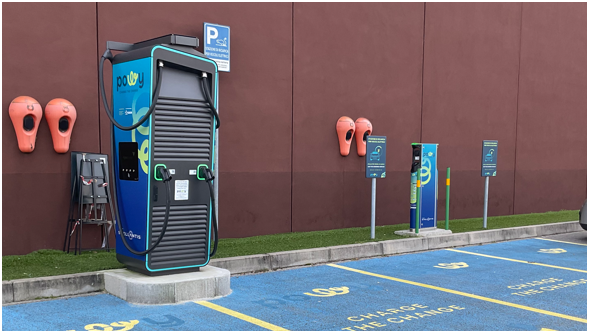


In the electric mobility sector, charging habits fall primarily into three categories: home/work charging, on-the-go charging (along major highways for long-distance travel), and destination charging.
The retail context fits perfectly into this last category. The principle of Destination Charging is straightforward: the charging service is integrated into an already planned primary activity. Users do not go to the supermarket solely to charge their cars, but instead take advantage of their stop to charge their vehicles while they shop.
This dynamic creates a direct synergy between the infrastructure and the retail location:
The most common methodological error in designing a retail charging infrastructure is ignoring the relationship between hardware power and dwell time (the average amount of time a customer spends inside the store).
Installing ultra-high-power charging stations (HPC — High Power Charging, over 150 kW) in a location where customers spend an average of three hours is technically and economically inefficient. If the car finishes charging in 15 minutes, the driver is forced to interrupt their activities to move the vehicle and avoid parking fines. Conversely, installing slow-charging stations at a fast-food restaurant where the average stop lasts 20 minutes does not provide enough energy to justify the investment.
Infrastructures are primarily divided into two technological categories:
The following table illustrates the correct system sizing based on the type of commercial facility:
| Type | Average Dwell Time | Recommended Technology | Reasoning |
| Convenience store / fast food | 15–30 min | DC Fast / HPC (50 kW – 150+ kW) | Short stop. Need to supply a large amount of kWh in a short period of time. |
| Supermarket / Large-Scale Retail | 45–90 min | DC (24 kW – 50 kW) | Average stop. One hour of charging at 50 kW provides approximately 300 km of real-world range. |
| Shopping Center / Outlet | 2–4 hours | AC (11 kW – 22 kW) combined with DC | Long-term parking. The “ AC ” charging service ensures a steady supply of power without requiring customers to move their cars early. |
| Movie Theaters / Gyms | 2–3 hours | AC (11 kW – 22 kW) | Fixed-Duration Operations. The AC charging system covers the duration of the event without causing abnormal power spikes on the grid. |
The installation of electric charging stations is not merely a cosmetic change or a superficial sustainability measure; rather, it directly impacts specific retail performance metrics.
To understand how this works in practice, let’s analyze a hypothetical scenario using illustrative data based on a medium-sized supermarket that installs a 50-kW “DC ” charging station with two outlets (capable of charging two vehicles at the same time).
In this case, the supermarket parking lot has replaced the traditional charging station in the user's daily routine.
The installation of charging stations requires careful technical planning to avoid operational issues or negative impacts on site operations.
Bringing charging to retail settings isn’t just about offering a simple courtesy; it’s about positioning the facility along new mobility routes. Properly calibrating the infrastructure’s capacity to match customers’ dwell time allows for investment optimization, transforming the time spent at the location into economic value for both the retail outlet and the consumer.
If you manage a commercial property, a supermarket, or a facility open to the public, Powy we’ll support you as a CPO (Charge Point Operator) in the design, installation, and management of your charging infrastructure.
We analyze the traffic patterns and characteristics of your parking facility to identify the most suitable mix of technologies: AC and DC. Depending on the partnership, Powy can handle the investment and management of the infrastructure, even at no cost to the partner.
Charging stations are also being integrated into the major networks and apps used daily by electric vehicle drivers, increasing the service’s visibility and the store’s appeal: Discover Powy ’s solutions for Retail and Real Estate.
It depends on the contractual model chosen. Options range from the sale of the infrastructure—with the retailer bearing the investment costs—to models in which the CPO covers both the investment and operating costs. There are also intermediate arrangements, in which costs and revenues are shared between the parties based on the agreements signed. Different levels of involvement can also be defined for management and maintenance, depending on the model chosen.
Clear horizontal and vertical signage helps identify charging-reserved parking spaces. Furthermore, when charging stations are publicly accessible and managed by a CPO, with charging made available through major MSPs and their apps, management systems may impose idle fees: charges that apply after a certain period following the completion of charging, incentivizing the user to vacate the space. In the case of customized management, however, different solutions and rules may be adopted, depending on the facility’s needs.
If the infrastructure— AC or DC —has been properly sized based on the store’s dwell time, in most cases the charging process is completed while the customer is still there. However, as mentioned, management platforms may apply so-called “idle fees”: a per-minute charge that kicks in after charging is complete, when the vehicle continues to occupy the charging station, encouraging the user to vacate it so it can be made available to other customers.

Powy a company that owns, develops, and manages Italy's leading independent network of public charging infrastructure for electric vehicles.
Founded in Turin in 2018, Powy is at the forefront of the transition to more sustainable mobility, offering an innovative charging infrastructure that uses only renewable energy.
Powy 's network includes quick, fast, and ultra-fast charging solutions strategically placed in public and private parking lots, supermarkets, shopping malls, and transportation hubs to ensure maximum convenience and accessibility for EV drivers. Each station is equipped with advanced technologies to provide a reliable and efficient charging experience.
Press Office: press@powy.energy