September 2, 2026
EU Auto Market: One in Five Cars Is Electric. Growth Figures and What This Means for the Charging Network

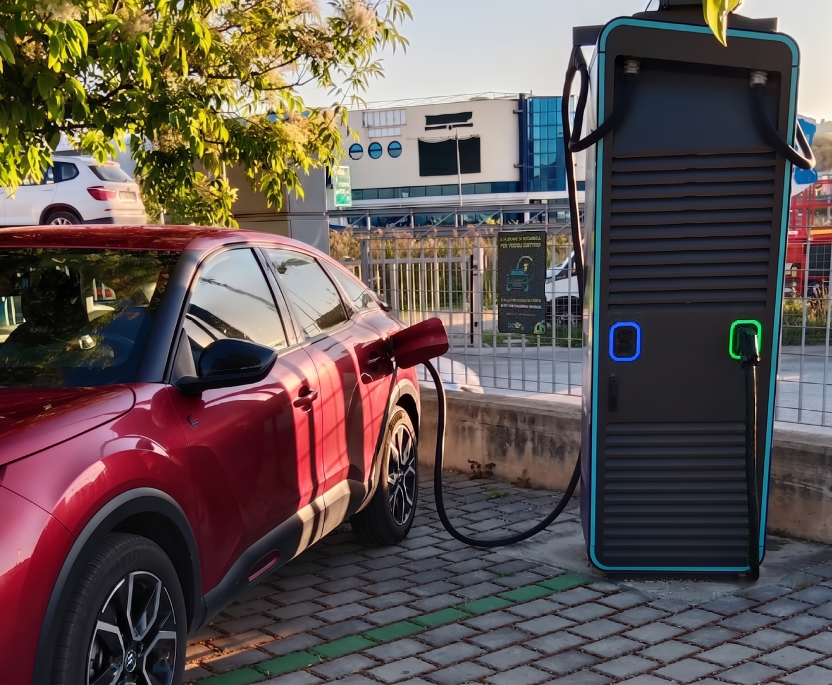


In the first six months of 2026, the European Union’s automotive market reached a symbolic and structural milestone: 20.7% of newly registered cars were fully electric (BEV). More than one in five cars put on European roads—a total of 1.22 million units in a single half-year—therefore have no internal combustion engine.
As electric cars finally move beyond the niche market of early adopters and enter the mainstream, the pressure on public infrastructure is also changing. Drivers are no longer just looking for “a place to charge,” but for a fast, widespread, and simple experience—one that increasingly resembles that of traditional refueling.
How is Italy responding to this continent-wide shift? With an unprecedented acceleration in infrastructure development. Let’s analyze European market data, figures on the Italian network, and the role of AFIR regulations in the evolution of the charging infrastructure.
Data from the first half of 2026 paint a picture of a transition that has now become structural. While purely electric vehicles (BEVs) account for more than 20% and plug-in hybrids (PHEVs) are approaching 10%, traditional engines continue to lose ground.
Gasoline-powered cars fell by 17.2%, dropping to a 22.2% market share, while diesel sales declined further, reaching 7.5%.
This shift in demand—driven both by major European automakers and by the entry of Asian brands, which have reached a 6% market share in the EU—calls for a change of pace on the infrastructure front as well.
With one in five new cars being electric, the number of drivers using the public charging network for business trips, tourism, and daily commutes is on the rise. As a result, the availability, reliability, and distribution of charging stations are becoming increasingly critical to supporting the growth of electric mobility.
In response to the rise in electric vehicle registrations in Europe, Italy's infrastructure has seen significant growth.
By the end of the second quarter of 2026, Italy had surpassed 84,564 public charging stations, with more than 17,000 new installations over the past twelve months.
To understand the scale of this growth, consider that in March 2022, there were just under 28,000 charging stations: in four years, the network has thus grown by about 226%.
The expansion involves not only the total number of available charging stations but also their distribution and charging capacity. In fact, the growth of the network helps meet both the needs of Italian drivers and the international traffic flows from European countries where electric vehicles are more widespread.
The most interesting aspect of the recent evolution of the Italian internet is not only quantitative but also qualitative.
A growing proportion of new installations falls into the Fast and Ultra-Fast direct current categories (DC), with capacities generally starting at 50 kW and capable of exceeding 300 kW.
This development is a response to the growing prevalence of electric vehicles that are increasingly efficient and capable of handling high charging power.
The growth of high-power charging therefore represents a natural evolution of the market, but that does not mean that the highest power output is always the best solution.
In fact, the choice of technology must also take into account the length of the user’s stay: a stop lasting just a few minutes has different requirements than a stay lasting several hours.
The expansion of the Italian network is part of the framework established by the European AFIR Regulation (Alternative Fuels Infrastructure Regulation), which aims to make electric vehicle charging increasingly accessible, widespread, and interoperable.
One of the goals is to make on-demand charging easier, allowing drivers to pay for a charging session without necessarily having to have a pre-existing contract with a provider or use a specific app.
In this context, AFIR introduces requirements regarding electronic and contactless payments for certain categories of infrastructure, with a particular focus on high-power stations along major European transportation corridors.
Starting January 1, 2027, for new public charging stations subject to the regulation, payment by card or contactless device will become an increasingly central part of the charging experience.
The goal is simple: to reduce barriers to access and make public charging as straightforward as filling up a gas tank.
The convergence of the growth in electric vehicles and the expansion of the charging network is opening up new opportunities for businesses, property managers, hospitality facilities, and local governments.
The growing number of electric vehicle drivers presents an opportunity for shopping centers, hotels, restaurants, and other facilities with parking lots.
Integrating charging infrastructure means offering an additional service, but it also creates an opportunity to attract and retain customers while they are parked.
The most suitable technology, however, is not necessarily the one with the highest power output: the design must be based on the type of location, the average duration of the stop, and user traffic patterns.
For businesses, the increased range of electric vehicles and the expansion of an increasingly widespread public charging network are makingthe electrification of fleets an increasingly realistic prospect.
The availability of Fast and Ultra-Fast infrastructure, combined with increasingly simple and interoperable payment methods, can also support professional use cases involving long travel times, such as sales forces, corporate fleets, and last-mile logistics.
In this case as well, the choice of infrastructure must be consistent with how the vehicles are used: not all fleets require the same power or the same charging technology.
For local governments, the growth of electric mobility makes it increasingly important to plan infrastructure based on the characteristics of the local area and mobility demand.
It is not just a matter of increasing the number of available charging stations, but of identifying where charging is truly needed, taking into account population density, traffic flows, commercial activities, tourist attractions, and connections to major roadways.
A well-distributed network can help make electric mobility more accessible and support the transition even in areas where the adoption of BEVs is still growing.
Do you want to attract the growing number of electric vehicle drivers and enhance the value of your parking lot or commercial property?
Powy It installs and manages charging infrastructure tailored to the characteristics of the location, user traffic, and mobility needs—ranging from alternating current solutions to fast and ultra-fast charging infrastructure—through various partnership models and agreements.
In the first six months of 2026, battery electric vehicles (BEVs) accounted for 20.7% of total new vehicle registrations in the European Union, exceeding 1.22 million units. When plug-in hybrids (PHEVs) are included, the market share of electrified vehicles exceeds 30%.
As of the end of the second quarter of 2026, Italy had more than 84,500 public charging stations. The network grew by 17,000 stations in just one year and by 226% compared to March 2022.
Fast charging stations deliver direct current (DC) with power outputs starting at 50 kW. Ultra-Fast (HPC) charging stations exceed 100/150 kW, often reaching 300 kW or more, allowing most of an electric car’s battery to be charged in 15–20 minutes.
Starting January 1, 2027, new public charging stations with a capacity of 50 kW or more installed along the European TEN-T road network must be equipped with POS or contactless readers to allow drivers to pay directly with a bank card, without having to register for a service via an app.
Disclaimer: The data and statistics presented in this article, updated as of September 2026, are based on the main official sources available at the time of writing. The data on vehicle registrations and automotive market shares in the European Union are based on ACEA (European Automobile Manufacturers’ Association) figures for the first half of 2026. For the development of the public charging network in Italy, industry monitoring data for the second quarter of 2026 were used. The regulatory framework is based on Regulation (EU) 2023/1804 (AFIR – Alternative Fuels Infrastructure Regulation). Although every effort has been made to ensure the accuracy of the content, any updates to sources, statistical revisions, or regulatory changes could result in variations from the data and information presented in this article.

Powy a company that owns, develops, and manages Italy's leading independent network of public charging infrastructure for electric vehicles.
Founded in Turin in 2018, Powy is at the forefront of the transition to more sustainable mobility, offering an innovative charging infrastructure that uses only renewable energy.
Powy 's network includes quick, fast, and ultra-fast charging solutions strategically placed in public and private parking lots, supermarkets, shopping malls, and transportation hubs to ensure maximum convenience and accessibility for EV drivers. Each station is equipped with advanced technologies to provide a reliable and efficient charging experience.
Press Office: press@powy.energy