Published on
Long-Term Parking at Airports and Train Stations: How to Design Charging Infrastructure for Transportation Hubs

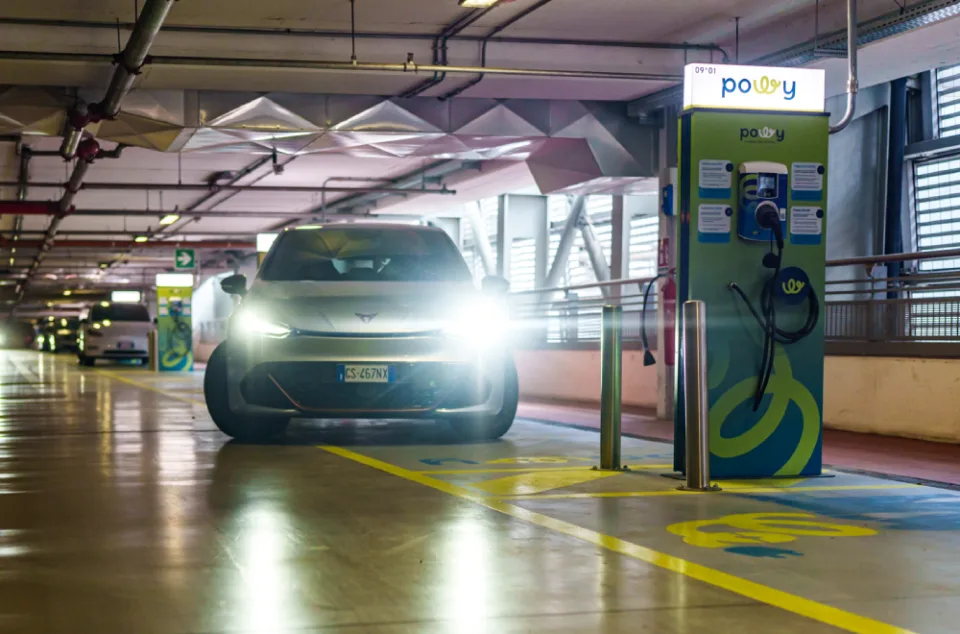


For those who manage parking lots at an airport or a rail hub, the electrification of parking spaces requires different assessments than those needed along highway networks. While reducing charging times is essential on major thoroughfares, in long-term parking areas it is necessary to consider the length of time vehicles remain parked, the availability of electrical power, and the utilization of parking spaces. In these contexts, installing only high-power stations could result in costs and infrastructure requirements that are disproportionate to actual needs. For this reason, designing an efficient network requires evaluating the technological mix best suited to parking durations and traffic flows—an area in which Powy offers solutions for developing charging infrastructure tailored to various types of areas.
In the debate on electric mobility, attention often focuses on high-power charging stations (DC s ranging from 50 kW to over 150 kW). However, in areas designated for multi-day parking, relying solely on fast charging creates three operational challenges:
For these reasons, the backbone of a long-term parking facility must rely on alternating current (AC) at a moderate power level (between 3.7 kW and 11 kW), which distributes energy gradually.
Direct current (DC) still plays a strategic role, but it should be reserved for specific areas:
| Stall Category | Parking Duration | Recommended Technology | Impact on the facility |
|---|---|---|---|
| Long-term parking (terminal and park-and-ride) | from 24 hours to more than 15 days | AC (3.7 kW – 11 kW) | low: diluted absorption, programmable via software |
| Interior valet parking areas | scheduled handling | DC (50 kW – 100 kW) | medium: a few fast checkout lanes staffed by employees |
| Kiss & Fly Zones and Hourly Parking | 15 to 45 minutes | DC Fast / HPC (50 kW – 150 kW) | High: Requires concentrated power for fast charging |
Airports and train stations have complex electrical grids with absolute, non-negotiable priorities: control towers, track signaling, safety systems, and terminal lighting must never be interrupted. The charging infrastructure must therefore integrate seamlessly without creating the risk of a blackout.
This is where Dynamic Load Management (DLM) comes in—software that monitors the building’s load in real time and allocates only the remaining power to the charging stations:
This smart management system smooths out peak demand and makes it possible to install a large number of charging stations without having to request costly upgrades to existing electrical systems.
At public on-street charging stations, idle fees are generally charged; these penalties may be calculated on a per-minute basis when a vehicle remains connected to the station after charging is complete. The terms of application, any grace periods, and the amounts vary depending on the operator and the network.
In airport and intermodal parking lots, where vehicles may remain parked for several days and users are not always able to move them once charging is complete, managing these rates requires specific considerations. Depending on the parking lot’s organization and commercial agreements with the operators involved, various solutions may be considered:
The choice of the most suitable model depends on the characteristics of the parking facility, the length of stay, the methods of access to the stations, and the agreements among the parties involved.
The partnership between Powy and FS PARK, the parking operator of the FS Italiane Group, is a concrete example of the development of charging infrastructure at Italian rail hubs. The project involves the installation of charging stations in parking lots near train stations, with the goal of promoting the integration of electric mobility and rail transportation.
The infrastructure has been deployed in several Italian cities, including Turin (Porta Susa), Rho, Lodi, and Rapallo, as well as locations such as Ferrara, Pisa, and Treviso. By mid-2025, the network developed as part of the collaboration included more than 160 parking spaces equipped with charging infrastructure in over 16 Italian cities. Overall, the “ Powy ” stations involved in the project recorded more than 10,000 charging sessions, confirming that users are taking advantage of the infrastructure.
The project demonstrates how the infrastructure configuration can be adapted to the characteristics of individual parking facilities: at Turin’s Porta Susa, for example, a 50-kW DC Fast charging station and eight 11-kW AC Quick charging stations were installed, with solutions tailored to the specific features of the underground parking facility and various payment options.
For parking lot operators and mobility managers, Powy does not propose a single, rigid model, but rather evaluates the most suitable solution on a case-by-case basis based on the technical characteristics of the site. To learn more about the strategic framework for air transportation and the operational implications for airports, please consult our analysis on airports and electric mobility.
Under normal conditions, no. The car’s onboard battery management system (BMS) cuts off the current as soon as the battery reaches the preset level. For extended parking periods, however, it is good practice to set a charge limit between 70% and 80% via the app or the onboard display, following the manufacturer’s guidelines to limit thermal stress on the battery’s chemical components.
In short-term parking areas (kiss & fly, hourly parking, or drop-off zones), high-power direct current charging stations (DC) are generally used to enable quick top-ups in 15–40 minutes. In long-term parking lots, low-power alternating current charging stations (AC) are installed, designed to deliver power gradually over several days.
The charge level achieved depends on several factors, including the actual duration of the stop, the energy required upon arrival, and the overall load on the hub’s grid during the stop. The DLM system optimizes power distribution based on grid conditions and available stop times, helping to ensure that the desired charge level is reached by departure time, subject to operating conditions.

Powy a company that owns, develops, and manages Italy's leading independent network of public charging infrastructure for electric vehicles.
Founded in Turin in 2018, Powy is at the forefront of the transition to more sustainable mobility, offering an innovative charging infrastructure that uses only renewable energy.
Powy 's network includes quick, fast, and ultra-fast charging solutions strategically placed in public and private parking lots, supermarkets, shopping malls, and transportation hubs to ensure maximum convenience and accessibility for EV drivers. Each station is equipped with advanced technologies to provide a reliable and efficient charging experience.
Press Office: press@powy.energy