October 2, 2026
How Many kW and kWh Does an Electric Car Need? A Practical Guide to Charging Units of Measurement

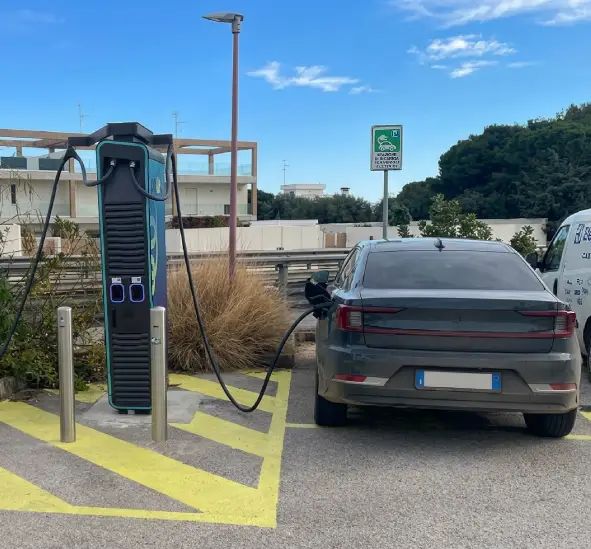


When you’re first getting started with electric vehicles, the car’s dashboard or the charging station’s display can seem complicated. Between power output, battery capacity, and consumption estimates, confusion often centers on two abbreviations that are very similar but fundamentally different: kW and kWh.
Understanding the difference between kilowatts and kilowatt-hours is not merely an academic exercise. It is the starting point for understanding how electric vehicle charging works, correctly interpreting the specifications of the vehicle and the charging station, estimating charging times, and—for those who manage charging infrastructure—properly sizing the service.
In this article, we will analyze exactly what these units measure, how they relate to one another, and what the actual variables are that influence the charging process.
The confusion stems from their common root, but from a physical standpoint, they measure two different quantities: power and energy.
To clarify this concept, the most effective approach is to use a hydraulic analogy:
In simple terms: power indicates the rate at which energy is transferred, while energy indicates the total amount of energy transferred.
| Parameter | Units of measurement | What does it represent? | Hydraulic Comparison | Application in EVs |
|---|---|---|---|---|
| Power | kW (kilowatt) | Energy Transfer Rate | Pipe Capacity | Power of the charging station or motor |
| Energy | kWh (kilowatt-hour) | Amount of energy transferred or stored | Amount of water in the tank | Energy stored in the battery |
| Consumption | kWh/100 km | Energy required to travel a certain distance | Water used over a certain distance | Vehicle Energy Consumption |
When evaluating an electric car, the figure expressed in kWh indicates how much energy the battery can store. To compare vehicles accurately, it is also important to distinguish between gross capacity and net or usable capacity: the latter indicates the energy actually available for the vehicle to use.
Battery capacity varies considerably depending on the vehicle's size and intended use: from the more compact batteries found in city cars to the higher-capacity batteries used in SUVs and vehicles designed for long-distance travel.
The kWh is also the unit used to measure the energy transferred during a charging session and typically serves as the basis for calculating the service fee, although the actual price paid may depend on the rate structure applied by the provider.
The kWh is also the unit used to express the energy consumption of an electric car: kWh/100 km indicates how much energy is used to travel 100 kilometers. The actual value varies depending on numerous factors, including speed, temperature, driving style, route, vehicle weight, and use of the air conditioning.
While the kWh indicates how much energy is transferred, the kW indicates the power at which the transfer occurs. In electric mobility, however, the actual power achieved does not depend solely on the charging station: it is the result of the interaction between the infrastructure, the vehicle, the battery status, and operating conditions.
There are two main types of charging, each based on different principles:
This is the mode commonly used at home, at work, and at public AC charging stations, generally with power ratings of up to 22 kW.
In a AC, the alternating current from the grid must be converted to direct current before it can be stored in the battery. This conversion is performed by the car's on-board charger (OBC).
For this reason, if a car is equipped with an 11-kW OBC and is connected to a AC charging station capable of delivering up to 22 kW, the charging power will be limited to the maximum power the vehicle can accept: 11 kW, provided that this power is actually available.
In “ DC ” charging—which is typically used for fast, high-power charging—the conversion from alternating current to direct current takes place at the charging station. The direct current is then supplied directly to the vehicle’s battery system, without passing through the OBC.
Even in this case, however, the station’s rated power does not necessarily match the power actually delivered. The vehicle communicates to the station how much power it can accept at any given moment, based on the system’s characteristics and the battery’s condition. The BMS (Battery Management System) helps manage these parameters, keeping the battery within the operating conditions specified by the manufacturer.
In theory, calculating the charging time is a simple mathematical operation:
Energy to be charged (kWh) ÷ Charging power (kW) = Theoretical time (hours)
However, this is a theoretical calculation that assumes a constant power output throughout the entire charging process. In practice, especially with direct current, the power output can vary significantly during the charging session.
Furthermore, drivers almost never charge their vehicles from 0% to 100%. The most common use case is topping off the charge from 20% to 80%.
Numerical example: Let’s imagine a car with a net 60 kWh battery. We need to charge it from 20% to 80%, so we need 60% of the battery’s usable energy, or 36 kWh.
If the power remained constant throughout the session, we would have:
These are theoretical times; in reality, the duration may be longer.
The main reason is the charging curve.
The power rating listed on the charging station—for example, 150 kW—represents the maximum power that the charging infrastructure is capable of providing, not the power that the car will necessarily receive throughout the entire charging session.
In many vehicles, when the battery is at a relatively low charge level, it is possible to achieve the highest charging power. As the charge level approaches higher levels, the power is generally reduced (tapering) to manage the battery's condition.
The actual power output also depends on other factors, including the state of charge (SoC), battery temperature, vehicle characteristics, the power available at the charging station, and the BMS management strategies.
For this reason, a car connected to a 150-kW charging station does not necessarily take about 14–15 minutes to charge 36 kWh, nor does it maintain 150 kW throughout the entire charging session. Similarly, reaching 80% does not necessarily take twice as long as reaching 40%—the time depends on the vehicle’s specific charging curve.
Understanding the relationship between kW and kWh has fundamental operational implications for various market participants:
Understanding the difference between kW (power) and kWh (energy) is essential for correctly understanding how electric vehicle charging works. Power indicates the rate at which energy can be transferred; energy, on the other hand, indicates how much energy is transferred or stored.
In practice, the time required for a charge does not depend solely on the charging station’s rated power and the battery’s capacity. Other factors also come into play, such as the vehicle’s limitations, the charging mode, the battery’s condition and temperature, and—especially at DC —the charging curve.
For this reason, choosing the right charging solution means taking into account the available power, the required energy, and the charging time.
Choosing the right balance between power, hardware technology, and management methods is essential for properly sizing a charging infrastructure. Powy supports companies, property managers, and parking lot owners every step of the way: from the feasibility study to identifying the configuration best suited to the site, all the way through to the installation and operational management of the charging stations. Discover the solutions Powy and transform your spaces into efficient charging hubs.
Yes, no problem at all. The charging station communicates with the car and will adjust the power output to match the limit of the car’s on-board charger (OBC). The vehicle is always safe and will charge at 11 kW.
This means that, based on your driving style and current conditions, the car draws 15 kilowatt-hours of energy from the battery to travel a distance of 100 kilometers. If your battery has a total capacity of 60 kWh, this consumption will give you a real-world range of about 400 km.
This is a safety system built into the car (BMS). As the battery cells charge, their internal resistance increases. Supplying energy at very high power (many kW) would cause overheating that could damage the battery’s chemical life, so the car instructs the charging station to slow down the current flow.
No. Almost all plug-in hybrid cars on the market lack a DC charging port (CCS2 connector) and can only be charged using AC power (AC). Furthermore, since their onboard chargers (OBCs) are often limited to 3.7 kW or 7.4 kW, charging will still take 2 to 4 hours, regardless of the charging station’s maximum power output.

Powy a company that owns, develops, and manages Italy's leading independent network of public charging infrastructure for electric vehicles.
Founded in Turin, Italy in 2018, Powy is at the center of the transition to more sustainable mobility, offering an innovative charging infrastructure that uses only 100 percent renewable energy.
Powy 's network includes quick, fast, and ultra-fast charging solutions strategically placed in public and private parking lots, supermarkets, shopping malls, and transportation hubs to ensure maximum convenience and accessibility for EV drivers. Each station is equipped with advanced technologies to provide a reliable and efficient charging experience.
Press Office: press@powy.energy