Published on
Electric Vehicle Charging in the Mountains and Tourist Destinations: The Cases of Sestriere, Sauze d’Oulx, and Madonna di Campiglio

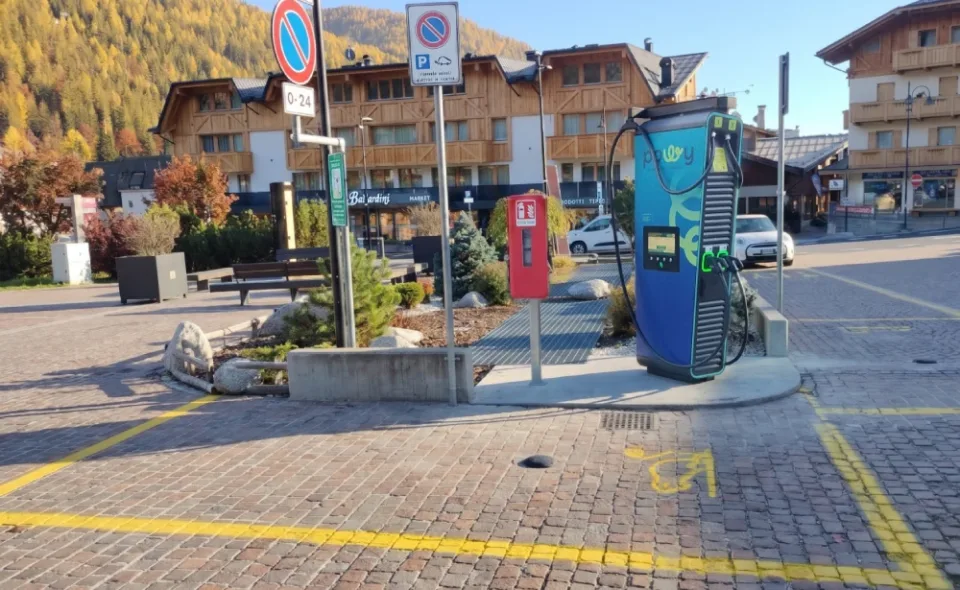


The rise of electric vehicles is also changing the mobility needs of tourists. Mountain destinations, ski resorts, and vacation spots are being called upon to incorporate new services to meet the needs of residents, visitors, and businesses.
In these contexts, the availability of charging infrastructure can help make a destination better prepared to accommodate electric vehicle travelers. The design, however, must take into account the specific characteristics of the area: seasonal variations in visitor flows, visitor concentration, length of stay, power availability, and parking distribution.
In fact, charging doesn't serve just one purpose. Hotel guests may leave their cars plugged in for several hours, while those stopping by for a visit or a day on the slopes may need a faster charge.
Mountain towns offer an interesting setting for observing how charging infrastructure can be integrated into services for tourists. In several towns across the Alps, Powy has installed charging stations in strategic locations, such as public parking lots, main streets, and squares frequented by residents and visitors.
Examples include Sestriere and Sauze d’Oulx in Piedmont, and Madonna di Campiglio and Pinzolo in Trentino.
In Sestriere, within the Via Lattea ski area, Powy offers four direct-current charging stations (DC), located between Piazza Agnelli and Via Monterotta, with two stations at each location. The town, situated at 2,035 meters above sea level, is one of the main tourist destinations in the upper Susa Valley.
In Sauze d’Oulx, another key destination along the Via Lattea, there are four charging stations: two AC stations (AC) on Viale Genevris and two DC stations (DC) on Viale Miramonti. The town is particularly popular during the ski season, but it is also a destination for summer tourism, thanks to its outdoor activities and proximity to the mountains of the upper Susa Valley.
In Madonna di Campiglio, a tourist resort in the Municipality of Pinzolo, in the heart of the Brenta Dolomites, Powy offers four direct-current charging stations (DC), distributed across two locations: two on Viale Dolomiti di Brenta and two in Piazza Brenta Alta. The charging infrastructure is located in one of Trentino’s leading tourist destinations, known for its ski resorts, outdoor activities, and lodging options. In Pinzolo, the center of Val Rendena and the seat of the municipality of the same name, there are two charging stations DC on Via Roma.
These are just a few examples of the areas where the Powy network is present, with infrastructure located in a variety of settings: from parking lots and downtown streets in towns to areas frequented by visitors heading to ski resorts and major tourist attractions.
The availability of AC and DC solutions also makes it possible to meet different charging needs: AC charging is suitable for longer stays, while DC charging allows for faster recharging.
The choice of technology and power depends primarily on the amount of time the driver spends at the location where the station is installed.
| Context | Suggested Solution | Primary need |
|---|---|---|
| Hotels and Accommodations | AC, typically 7.4–22 kW | Charging During an Overnight Stay or an Extended Stop |
| Parking Lots at Ski Resorts and Attractions | AC, 11–22 kW, depending on the duration | Recharge throughout the day |
| Central parking lots and walkways | DC, for example, 50–100 kW | Charging during a short stop |
| Transit Areas and Road Connections | DC high-power, depending on demand and the available power grid | Reduction in dwell time |
| Fleets and Service Vehicles | AC or DC, depending on shifts and routes | Charging Scheduling Based on Vehicle Usage |
There is no one-size-fits-all solution for all locations. A hotel may have different needs than a public parking lot near the ski lifts or a rest area along a connecting road.
Planning must therefore begin with an analysis of traffic flows, average dwell time, and the availability of the power grid.
Tourist destinations often experience significant fluctuations in visitor numbers throughout the year. A ski resort, for example, may see peaks in visitor numbers on weekends and during the winter holidays, while a mountain destination may see visitor numbers spread out even during the summer months.
This variability must be taken into account when designing the infrastructure. It is necessary to assess how many cars could use the stations at the same time, how much power is available, and how to distribute the energy among the various charging points.
Dynamic Load Management (DLM) systems allow the available power to be distributed among multiple charging points, adjusting it to match demand and the system's limits. This makes it possible to manage multiple charging sessions simultaneously, reducing the risk of exceeding the available power.
Charging must be integrated into the overall management of parking facilities. In tourist destinations, parking spaces can be in particularly high demand, especially during peak seasons.
It is therefore important to establish clear rules regarding the use of these spaces, the duration of parking, and the possible imposition of fees for prolonged occupancy after charging is complete.
Occupancy detection systems can also contribute to parking space management by providing useful information to operators and helping to identify any unauthorized parking.
An infrastructure intended to serve visitors from other regions or from abroad must be easy to use for drivers with different habits and payment methods.
Interoperability allows users to access charging stations through various apps and mobility service providers, while payment solutions such as POS terminals and QR codes enable users to start a charging session without having to use a dedicated app.
Having access to up-to-date information on the location, power capacity, availability, and rates of charging stations is another important factor for anyone planning a trip.
Electric vehicle charging can become part of a destination’s service offerings. For lodging facilities, parking lots, and local governments, investing in adequate infrastructure means preparing for evolving mobility needs.
The examples of Sestriere, Sauze d’Oulx, Madonna di Campiglio, and Pinzolo illustrate some of the ways in which the charging network can be integrated into mountainous areas, through solutions that vary in terms of technology and location.
To achieve tangible results, however, it is necessary to start by considering the characteristics of the area and the habits of those who use it. The choice of technologies, the location of stations, and operational management must be evaluated in a coordinated manner, with a medium- to long-term perspective.
There is no single number that applies to all locations. The number of charging stations depends on the number of visitors, the presence of residents and vehicle fleets, seasonal factors, and the average length of time vehicles stay.
It depends on the context. The AC charging option is suitable for extended stops, such as overnight stays or a full day of activities. The DC charging option, on the other hand, meets the needs of those who need to minimize their stop times.
The design must take into account peak demand and available power. Dynamic load management systems can distribute power among multiple charging points based on current needs.
It can serve as an additional service for residents and visitors who use electric vehicles, complementing the destination's other services and infrastructure.

Powy a company that owns, develops, and manages Italy's leading independent network of public charging infrastructure for electric vehicles.
Founded in Turin in 2018, Powy is at the forefront of the transition toward more sustainable mobility, offering an innovative charging infrastructure that uses 100% renewable energy—whose origin is certified by Guarantees of Origin (GO)—on its proprietary network, Powy.
Powy 's network includes quick, fast, and ultra-fast charging solutions strategically placed in public and private parking lots, supermarkets, shopping malls, and transportation hubs to ensure maximum convenience and accessibility for EV drivers. Each station is equipped with advanced technologies to provide a reliable and efficient charging experience.
Press Office: press@powy.energy