July 23, 2026
How Long Does It Take to Charge an Electric Car on the Highway? The Complete Guide

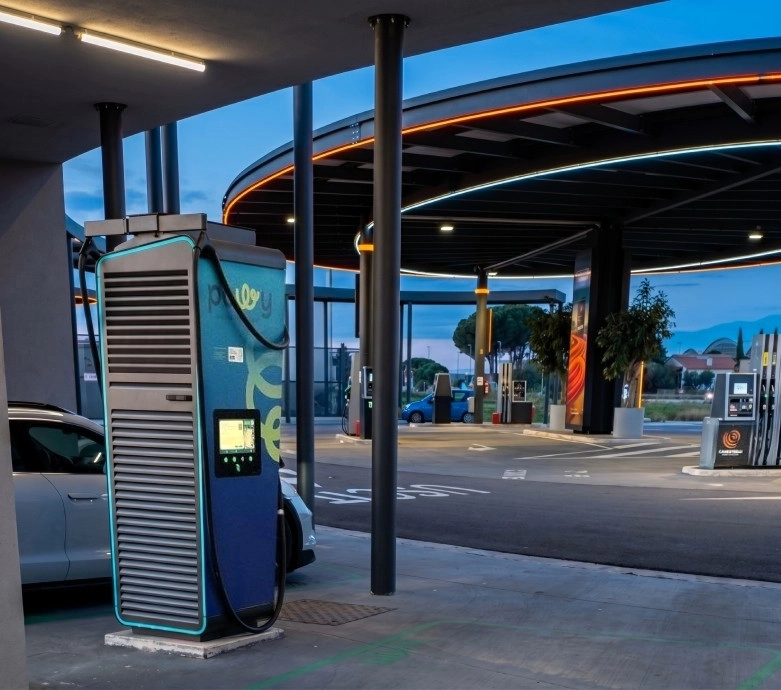


Embarking on a long trip in an electric car requires a slight shift in mindset: it’s no longer a matter of “filling up” in a few minutes, as with traditional fuels, but rather of optimizing your stops. Thanks to the impressive expansion of high-power charging networks, traveling by electric car has become not only feasible but also extremely comfortable.
But the key question for travelers remains: How long will I have to wait at the charging station?
While the quick answer is “on average, between 15 and 30 minutes,” the exact answer depends on a number of physical, technological, and environmental factors. In this article, we’ll take a detailed look at everything that affects charging times, to help you plan your trips with complete peace of mind.
The first thing to understand is the type of infrastructure you’ll encounter along your route. Outside urban areas— along highways, expressways, or in the immediate vicinity of toll plazas— direct current (DC) charging is used almost exclusively; this bypasses the car’s internal charger by sending power directly to the battery.
DC charging stations DC into two broad categories:
In addition to the charging station’s power output, there are other crucial factors that the infrastructure and the car “negotiate” the moment you plug in the cable.
1. The maximum power accepted by the car (BMS)
You can connect your car to a 300-kW HPC charging station, but if your vehicle’s Battery Management System (BMS) is designed to accept a maximum peak of 130 kW, the charging rate will never exceed that threshold. Before a trip, it’s helpful to know the DC charging peak DC by your car’s manufacturer.
2. Battery capacity (kWh)
Just like with gas tanks, size matters. An electric SUV designed for long trips may have an 80 kWh battery, while a compact model might have as little as 50 kWh. Given the same power output from the charging station, the larger battery will naturally take longer to store the total energy, even though it will provide you with more kilometers of range once charging is complete.
3. State of Charge (SoC) and the charging curve
This is the most important concept for electric vehicle drivers. Charging a lithium-ion battery is not linear.
4. Battery Temperature and Weather
Lithium batteries are “weather-sensitive”: they perform best at temperatures between 20°C and 25°C. If you’re traveling in the middle of winter and the battery is cold, the system will limit the charging power to prevent damage to the cells (the “Coldgate” phenomenon). Conversely, after a long highway trip in the summer, a battery that’s too hot will need to be cooled by the internal system before it can accept high charging power.
5. Power Sharing
At some charging stations, if two cars connect to the same charging station at the same time (for example, one equipped with two cables), the total power is divided. A 150-kW charging station might supply 75 kW to each vehicle, which increases charging times.
To give you a clearer picture, here are two typical scenarios during a long trip using an Ultra-Fast (HPC) charging station:
Scenario A – Family SUV (77 kWh battery, 170 kW peak power): Arrival at the charging station with 15% battery remaining. Goal: Reach 80% to continue the trip (approximately 250–300 km of range regained). Estimated time: 25–30 minutes.
Scenario B – Compact crossover (52 kWh battery, 100 kW peak): Arrival at the charging station with 20% battery remaining. Goal: Reach 80% (approximately 180–200 km of range restored). Estimated time: 25–35 minutes (the peak charging rate is lower, so the charging time is equivalent to that of the SUV).
The transition to electric vehicles shouldn’t slow you down. To travel with complete peace of mind, it’s essential to be able to rely on a modern, reliable, and extensive charging network. With over 1,400 proprietary charging stations across Italy and Spain, Powy a high-quality infrastructure designed to meet every need: from AC charging solutions to DC fast charging DC ultra-high-power HPC charging.
Our stations are designed to offer you maximum flexibility: they are not located at highway rest areas, but are strategically positioned just outside the toll plazas or along major suburban thoroughfares. This way, you can combine charging with a truly relaxing break in commercial areas that offer dining, shopping, and quality services.
Your freedom to travel isn’t limited to the Powy network: throughthe “ Powy ” app, you can also conveniently accesscharging stations from dozens of other interoperable providers across Europe, managing your trips with ease from a single app. Plus, for a truly sustainable journey from start to finish, all our charging stations are powered by energy from renewable sources.
Get ready for your next trip with peace of mind. Download the Powy app or visit our interactive map to find charging stations along your route!
The scenarios and charging information provided in this article are for illustrative purposes only and may vary depending on various factors related to the vehicle, the infrastructure, and conditions of use. For accurate and up-to-date information on the performance of a specific model, please refer to the specifications provided by the vehicle manufacturers.
To protect the battery. Once the charge level exceeds 80%, the car’s management system reduces power output to balance the internal cells and prevent overheating. For this reason, when traveling, it’s best to stop charging at 80% and then resume later.
No, DC fast-charging stations already come with their own built-in cable (usually with a CCS Combo 2 connector). All you have to do is park, connect the cable to your car, and start charging.
Yes, absolutely. Electric car charging systems and charging stations are waterproof and equipped with rigorous safety features. There is no risk involved in plugging in or unplugging your car in the rain.

Powy a company that owns, develops, and manages Italy's leading independent network of public charging infrastructure for electric vehicles.
Founded in Turin in 2018, Powy is at the forefront of the transition to more sustainable mobility, offering an innovative charging infrastructure that uses only renewable energy.
Powy 's network includes quick, fast, and ultra-fast charging solutions strategically placed in public and private parking lots, supermarkets, shopping malls, and transportation hubs to ensure maximum convenience and accessibility for EV drivers. Each station is equipped with advanced technologies to provide a reliable and efficient charging experience.
Press Office: press@powy.energy