Published on
Where to Place Charging Stations in a Hotel Parking Lot: A B2B Strategic Guide

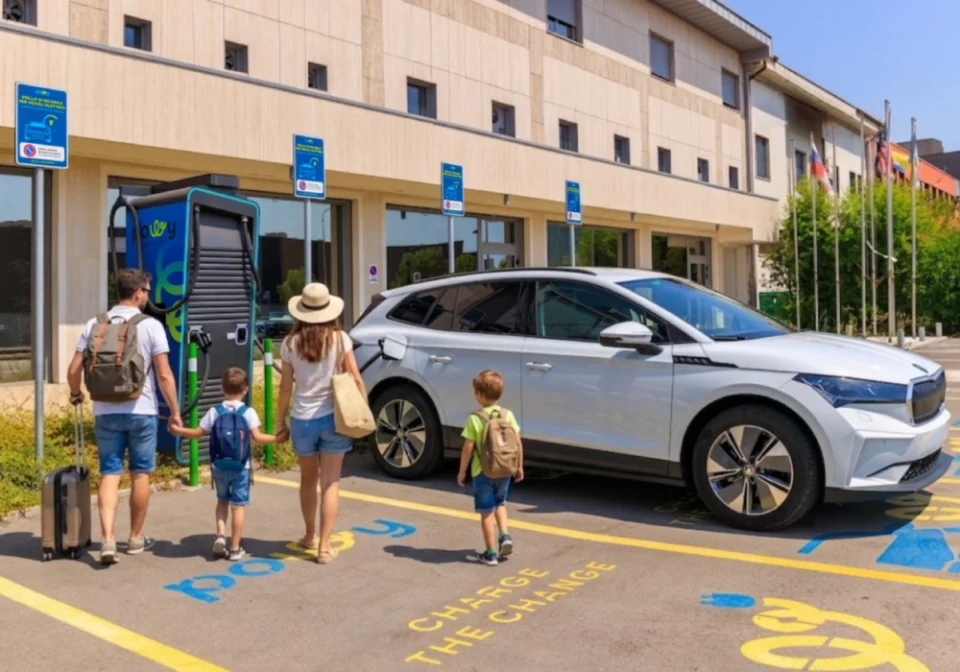


The installation of electric vehicle charging infrastructure at lodging facilities is no longer merely a decorative feature or an ancillary service: today, it is a key factor in the decision-making process for an increasingly large number of business travelers, Italian tourists, and international guests.
However, installing a charging station in a hotel parking lot is not simply a matter of mounting a device on a wall and plugging in a cable. The choice of the exact location for the charging stations directly affects the cost of construction work,the efficiency of the electrical system, user safety, and the perceived quality of the guest experience.
Charging stations must be designed to ensure maximum ease of use for all types of vehicles (from city cars to large SUVs).
When designing the parking lot, the following must be taken into account:
The strategic placement of charging stations also serves specific marketing and communication objectives for the lodging facility:
Placing 1 or 2 clearly visible stations near the hotel entrance or along the main driveway conveys an immediate message of innovation, environmental awareness, and a commitment to service. This placement creates a positive visual impact on arriving guests and enhances the brand’s image.
Underground garages or covered parking areas provide the ideal environment for guests who leave their cars parked overnight. Protection from the elements (rain, snow, and summer sun) ensures a high level of convenience when plugging in the charging cable and offers greater peace of mind to those who leave a valuable vehicle charging for several hours.
Charging typically takes place in the evening or at night, when guests return to the hotel after a day of work or sightseeing. The designated area should therefore meet high standards of passive safety:
One of the biggest sources of frustration for an electric vehicle owner is arriving at a hotel and finding the charging station occupied by a gasoline-powered car or an electric vehicle that has already finished charging but hasn’t been moved. This phenomenon is known in the industry as “ICEing” (from the acronym “Internal Combustion Engine”).
To avoid conflicts and ensure service availability:
From a purely technical and economic standpoint, the location of the charging station relative to the electrical panel is the factor that has the greatest impact on the installation estimate:
For lodging facilities, the standard hardware solution consists of alternating current (AC ) charging stations AC kW or 22 kW). During an overnight stay (typically 8–10 hours), 11 kW of power is more than enough to ensure that any vehicle is fully charged.
To prevent the simultaneous activation of multiple charging stations in the evening (while air conditioners, kitchen appliances, and hotel lighting are in use) from causing the main circuit breaker to trip, it is essential to implement a Dynamic Load Management (DLM) system:
How Load Management Works in Hotels: The system monitors the building’s total electricity consumption in real time. When the facility is using a lot of energy (e.g., during dinner service), the DLM temporarily reduces the power supplied to the charging stations. At night, when the hotel’s energy consumption drops, the system automatically reallocates the maximum available power to the vehicles being charged. This allows for the installation of more charging stations without having to pay for a permanent increase in the contracted power capacity.
As can be seen from the previous points, the charging infrastructure is a complex system. Purchasing a charging station on your own or relying on unqualified installers exposes the hotel to real risks: unexpected construction costs, inadequate management of electrical loads (with the risk of disruptive power outages), and the lack of software to manage payments and unauthorized use.
It is at this stage that it becomes crucial to rely on a qualified partner such as Powy. Choosing Powy means completely relieving the facility of all technical and operational burdens. From the preliminary site survey to optimize cable routing, to the installation of state-of-the-art hardware with integrated load balancing (DLM), all the way to adding the facility to the maps of international charging networks. The hotel no longer has to act as an energy manager; instead, it can delegate the entire process to Powy, offering guests an impeccable, uninterrupted service backed by dedicated 24/7 technical support.
Evaluation Checklist for Installing Charging Stations in Hotels:
- [ ] Distance from the panel: Does the selected area limit the length of the cable runs from the main electrical panel?
- [ ] Maneuverability and dimensions: Are the parking spaces wide enough to allow parking both facing forward and facing backward?
- [ ] Security and lighting: Is the area well-lit at night and protected by bollards?
- [ ] No Parking Signs: Are green/blue markings on the ground and dedicated vertical signs provided?
- [ ] Energy Management (DLM): Is dynamic load balancing provided to prevent power spikes?
- [ ] Future expansion: Have oversized conduits been installed to allow for the addition of new charging stations in the coming years without having to reopen the construction site?
Would you like to offer a charging service to your guests without having to directly manage the technical and operational complexities? Trust Powy to design, install, and manage a customized infrastructure for your lodging facility.
There is no standard number that applies to all facilities. The ideal number depends on the number of available parking spaces, the guest profile, the expected adoption rate of electric vehicles, and the possibility of expanding the system in the future. A modular design allows you to start with an appropriate number of charging points and increase that number over time.
Not always. Thanks to dynamic load management systems, it is possible to intelligently distribute the available energy among the charging stations and the facility’s other power consumers, preventing overloads and optimizing the existing system.
For most lodging facilities, alternating current (AC) charging solutions are the most suitable, as they allow vehicles to be charged during extended stays, such as overnight stays. Direct current (DC) charging solutions may be worth considering for hotels with guests passing through or who need faster charging.
The ideal location depends on the facility, but it is generally advisable to choose areas that are easily accessible and visible, such as main parking lots, areas near the entrance, or parking spaces designated for long-term parking. It is also important to consider proximity to the electrical panel and the accessibility of the spaces for all users.
Yes, the property can choose whether to reserve the service exclusively for guests or to make it available to non-guests as well. Managing the service through digital platforms allows the hotel to configure access, payments, and terms of use based on its objectives.

Powy a company that owns, develops, and manages Italy's leading independent network of public charging infrastructure for electric vehicles.
Founded in Turin in 2018, Powy is at the forefront of the transition to more sustainable mobility, offering an innovative charging infrastructure that uses only renewable energy.
Powy 's network includes quick, fast, and ultra-fast charging solutions strategically placed in public and private parking lots, supermarkets, shopping malls, and transportation hubs to ensure maximum convenience and accessibility for EV drivers. Each station is equipped with advanced technologies to provide a reliable and efficient charging experience.
Press Office: press@powy.energy