


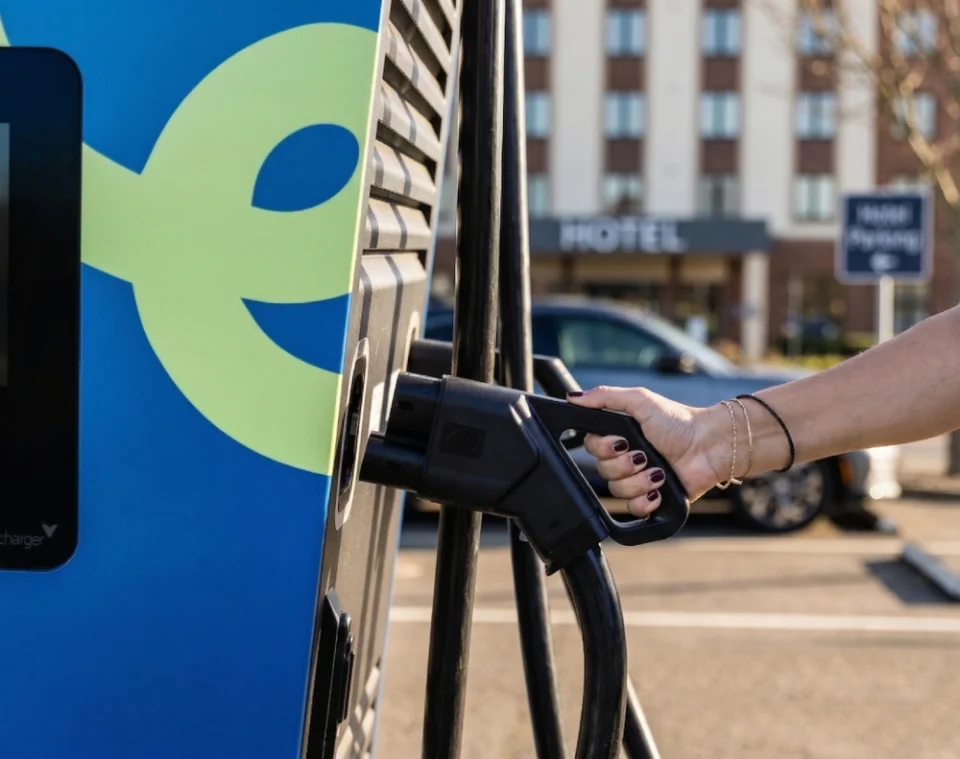
Electric vehicle charging at hotels has become one of the most discussed topics at the intersection of sustainable mobility and tourism.On the one hand, travelers with electric vehicles are looking for accommodations where they can conveniently charge their vehicles overnight. On the other hand, hoteliers are considering whether and how to incorporate this service into their offerings.
In Italy, the market is still booming: according to data from Motus-E, only 2.8% of public charging stations are located at hotels, B&Bs, or other lodging facilities—a figure that highlights both the lag in development and the enormous growth opportunity for those who act now.
Why charging at a hotel is different from charging on the highway
Understanding theunique characteristics of the hotel industry is essential to grasping how charging works—and how it should work—in these facilities. A hotel is not a rest stop: stays are long, typically 8–12 hours, and this completely changes the type of infrastructure required.
Guests who arrive at the hotel in the evening and leave in the morning don’t need ultra-fast charging: they have plenty of time to fully charge their vehicle even with a simple 7–11 kW wallbox. The priority isn’t speed, but ease of access, reliability, and the assurance that their car will be fully charged in the morning without having to worry about a thing overnight.
An exception is made for facilities located along major transit routes or those that primarily accommodate short-term stays: in these cases, a 22 kW charging station or even a fast-charging station may be justified to meet the needs of those who stay for only a few hours.
How do guests access the service?
How you access charging at a hotel depends primarily on who owns and operates the charging station: the hotel itself or a third-party network operator.
Charging station owned by the hotel
When a hotel manages its own infrastructure, it has complete freedom over every aspect; on the other hand, it must deal with technological and bureaucratic complexities that are far from trivial. The most common solutions adopted are:
- Direct access:The outlet is always active; guests simply plug in the cable without any authentication. This is the most convenient option, typically used when charging is included in the stay.
- Hotel RFID card:issued at check-in; hold it up to the reader to log in.
- QR code:Scanning the code on the payment terminal opens the session in your browser, without requiring an app; payment is typically made by credit card directly online.
- Hotel apps:a rare solution, typically adopted by properties with proprietary digital ecosystems (e.g., a stay app that also integrates charging management)
- PIN code:The hotel assigns a unique code to each guest, which can also be used for promotions or different rates (e.g., overnight guests vs. restaurant-only guests)
Kiosk operated by a third-party provider
When the charging station is part of a partnership agreement or similar arrangement, access is subject to the network’s standards and the terms of the contract. In this case, the guest uses the service just as they would at any other location on the public network:
- RFID card (owned by the user or the facility):the designated operator’s card used to start and end the charging process, or, in some cases, a card from an interoperable partner.
- Home network app / roaming network app:Depending on the agreements in place, the guest uses the app of the network that operates the charging station or that of another interoperable network to start and pay for the session.
- QR codes with direct payment:increasingly common, they allow you to get started without registration or a membership card.
- POS / card payment:Some payment terminals have a contactless card reader built directly into the device.
Charging times: why nighttime is the perfect time
To give you a concrete idea of how much your device charges during a typical overnight stay at a hotel, here are some practical guidelines based on an 8-hour stay:
- 7 kW wallbox:delivers up to 56 kWh → full charge for most mid-size cars
- 11 kW wallbox:delivers up to 88 kWh → fully charges even large SUVs
- 22 kW Wallbox:delivers up to 176 kWh → full charge for any vehicle, with plenty to spare
In practice, even if you arrive at the hotel with your battery nearly dead, you’ll find your car fully charged in the morning, with no range anxiety for the next day. It’s one of the benefits most appreciated by electric vehicle travelers.
The Market: Where We Stand Today in Italy and Europe
The European landscape is one of a rapidly expanding market, with infrastructure that is growing but still needs to bridge significant gaps, particularly in the hospitality sector.
According to the seventh edition of the report “Public Charging Infrastructure in Italy,” produced by Motus-E in collaboration with GSE and RSE (March 2026), as of December 31, 2025, Italy had 73,047 public charging points, an increase of 8,656 units compared to the previous year.
In the automotive sector, 2025 marked a turning point: electric vehicle registrations rose by 46.1% compared to 2024, with approximately 94,000 new BEVs sold that year. In a European comparison, Italy stands out with one charging station for every six electric vehicles, outperforming France, Germany, and the United Kingdom.
Yet, in Italy, the hospitality sector remains underserved, with few well-equipped facilities. This represents a significant gap compared to steadily growing demand and a real opportunity for those who choose to act now.
How to offer charging services at hotels: Powy solutions
For hoteliers who want to incorporate charging services into their offerings without dealing with technical complexities or risky investments, Powy three partnership options designed to meet a variety of needs.
Co-investment: A Shared Electric Future
- Joint Investment: Mutual Growth Through a Shared Financial Commitment
- Transparent agreements: ownership percentages specified in the contract
- Sharing Risks and Benefits: A Fair and Collaborative Model
- Powy Management: Installation and activation handled by industry experts
- Revenue stream: Earn a percentage of top-up transactions
Partnership: Sustainable Growth with Powy
- No upfront investment: Powy hardware, installation, and startup costs
- Comprehensive Powy management: quick installation and ongoing maintenance at no cost to you
- Business continuity: an efficient installation process managed by professionals
- Guaranteed income stream: earn a percentage on every top-up
- Scalable growth: a collaboration model designed for long-term growth
Purchase: Your Turnkey Charging Infrastructure
- Easy purchasing: Powy guides Powy from hardware selection to installation
- Reliable infrastructure: ongoing management and maintenance provided by Powy
- Customized solutions: scalable charging systems
- Smart software: advanced tools for managing and optimizing charging
- Earning potential: Profit opportunities through public access to your infrastructure
Want to offer charging services to your guests in a simple, reliable, and hassle-free way? Powy the right solution for every accommodation facility: from a free technical site survey to 24/7 operational management, with the option of zero upfront investment. Contact us today and turn charging into a valuable service for your guests.
FAQ: Do hotel guests need to bring their own charging cable?
It depends on the type of charging station installed. The most common Mode 3 charging stations require guests to use their own charging cable (Type 2), which is typically provided with the vehicle at the time of purchase. Some facilities equipped with charging stations featuring an integrated cable offer plug-and-play charging without the need to bring anything. It is always advisable to check which type of connection is available before check-in.
About Powy
Powy a company that owns, develops, and manages Italy's leading independent network of public charging infrastructure for electric vehicles.
Founded in Turin, Italy in 2018, Powy is at the center of the transition to more sustainable mobility, offering an innovative charging infrastructure that uses only 100 percent renewable energy.
Powy 's network includes quick, fast, and ultra-fast charging solutions strategically placed in public and private parking lots, supermarkets, shopping malls, and transportation hubs to ensure maximum convenience and accessibility for EV drivers. Each station is equipped with advanced technologies to provide a reliable and efficient charging experience.
Press Office: press@powy.energy