May 25, 2026
Where to Install Charging Stations the City: A Strategic Map for a Service That Works

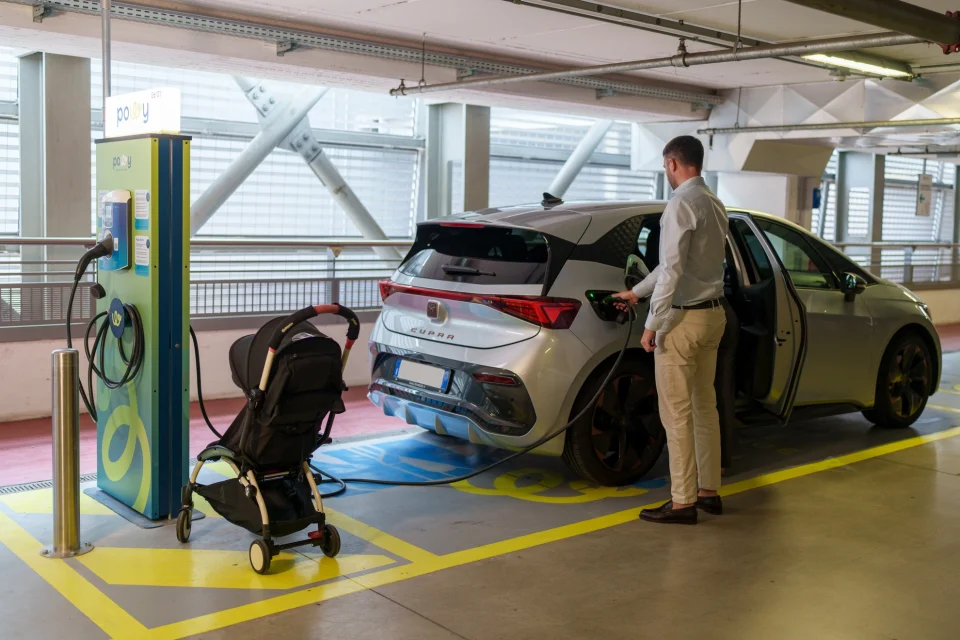


Installing a charging station is not simply a matter of urban design. It’s not enough to find an available space and set up an infrastructure with a socket. The real challenge—the one that transforms an investment into a tangible, widely used, and sustainable service over time—is strategic geolocation.
In the city, charging works when it stops being an extra “hassle” for the user and becomes a natural part of what they’re already doing. The principle is simple: it’s not the car that has to go to the charging station; it’s the charging station that has to be there where the car stops.
The first question to ask is: How long will the car be parked here?
The more predictable and natural the stop is, the more likely the charging station is to be used consistently. A high-turnover parking spot with stops lasting just a few minutes—such as in front of a tobacco shop or a pharmacy—is, paradoxically, less effective than a location where a car remains parked for an hour or more. The most efficient urban charging is the kind that fits seamlessly into the day without interrupting it.
There are strategic locations that combine traffic volume, accessibility, and ideal dwell times:
Not all installations follow the same logic, and it is essential to distinguish between the roles:
In both scenarios, the technical, regulatory, and strategic complexity makes it necessary to rely on specialized operators. Industry partners such as Powy can support projects with flexible models, ranging from direct investment purchases to partnership arrangements, working alongside the client (public or private) during the analysis, installation, and ongoing management phases.
To ensure the long-term efficiency and sustainability of infrastructure, public and private entities must avoid three major risks:
In conclusion, the value does not lie simply in the “charging point” itself, but in the ability to analyze the local area, understand traffic flows, and identify the right location. It is this strategic approach that makes it possible to transform a simple parking space into a high-performance service infrastructure, following a logic that specialized operators such as Powy are now bringing to the market.
The ideal power output for a charging station in the city depends primarily on the type of parking intended and the context in which it is installed. Solutions ranging from 11 to 22 kW are generally best suited for locations such as supermarkets, shopping centers, or offices, where cars remain parked for a medium to long period of time and charging can take place without urgency. Lower power ratings, on the other hand, can be an effective choice in park-and-ride lots or extended-stay parking areas, where vehicles remain parked for several hours. DC charging stations, however, are ideally located along high-traffic thoroughfares or at strategic points in the city, where users need quick charges during short stops.
The physical footprint of a charging station is generally small. The truly critical factors are the availability of dedicated parking spaces and proximity to an electrical connection point. The latter is particularly important because it can significantly affect the cost and complexity of installation.

Powy a company that owns, develops, and manages Italy's leading independent network of public charging infrastructure for electric vehicles.
Founded in Turin, Italy in 2018, Powy is at the center of the transition to more sustainable mobility, offering an innovative charging infrastructure that uses only 100 percent renewable energy.
Powy 's network includes quick, fast, and ultra-fast charging solutions strategically placed in public and private parking lots, supermarkets, shopping malls, and transportation hubs to ensure maximum convenience and accessibility for EV drivers. Each station is equipped with advanced technologies to provide a reliable and efficient charging experience.
Learn more: wpowy.energy